For example,
and as I’ve often emphasized, philosophers and historians of science commit
this error when they claim that the key theses of Aristotelian philosophy of
nature (concerning substantial form, natural teleology, etc.) were refuted by
modern science. As I
have argued, what modern science has refuted are really only certain
auxiliary empirical assumptions that medieval Aristotelians took for granted
when applying these ideas, but not the ideas themselves.
Naturally,
it would also be fallacious to judge that some application of a theory, or some
auxiliary assumption made when developing that application, must be correct
simply because the theory itself is sound.
A modern Aristotelian would be committing such a fallacy if, for
example, he judged that, since Aristotelian philosophy of nature is after all still
defensible, we should conclude that medieval empirical science too is still
defensible and that Galileo and company were all wrong.
A very
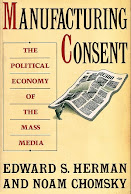
different example is provided by the “propaganda model” of mass media famously
associated with Noam Chomsky, and developed by Chomsky and Edward Herman in
their book Manufacturing
Consent. Chomsky is
well-known for applying this model to media coverage of U.S. foreign policy, in
the service of his particular (anarchosyndicalist) brand of left-wing politics
and economics. Many right-wingers
dismiss Chomsky’s model because they reject his left-wing assumptions and the
claims he makes about U.S. foreign policy in the name of the model. Many left-wingers, finding the model itself
plausible and already sympathetic to some the political and economic
assumptions Chomsky brings to bear when applying it, judge that the
applications must be sound. But here too
the three factors – the model itself, the auxiliary political and economic
assumptions in question, and the various applications to particular cases –
must be distinguished. Acceptance (or
rejection) of one doesn’t entail acceptance (or rejection) of the others.
Wholesale
acceptance or rejection is nevertheless common, and tends to be vehement, for
Chomsky is a polarizing figure. This is
unsurprising. On the one hand, he is
obviously brilliant and has made important contributions to modern intellectual
life – to linguistics, of course, but also to philosophy, as I
have noted here before. Even
when you think what he is saying is batty, he is always interesting to listen
to, and is independently-minded enough to annoy even his fans from time to
time. On the other hand, especially on
political matters he is, to say the least, prone to wild overstatement and sweeping
remarks. He has an annoying habit of
reeling out long strings of peremptory assertions, some of them reasonable,
some unreasonable, but in any case largely tendentious and controversial yet
presented as if no rational and well-informed person could possibly disagree. He is himself also insufficiently careful to
distinguish his “propaganda model” from the left-wing political and economic
assumptions that influence his application of it.
My own
political and economic views are most certainly not left-wing, though I also
reject the libertarian or doctrinaire free-market position that is Chomsky’s
usual target. In my opinion, capitalism
is a mixed bag. You needn’t either
accept the whole thing or reject the whole thing. Left-wingers are too quick to throw the baby out
with the bathwater, and right-wingers are too willing to swallow the bathwater
in the name of saving the baby. In any
event, my fundamental political principles are subsidiarity, solidarity, and pietas rather than, say, liberty,
equality, and fraternity (much less diversity,
equity, and inclusion). My
basic economic principles are those of popes Leo
XIII and Pius
XI. In short, I approach
these issues from the point of view of Catholic social teaching and Thomistic
natural law theory.
Naturally, since
my political and economic commitments are very different from Chomsky’s, I
disagree with much of what he says when he applies his “propaganda model” to
specific cases. For example, while I
agree with him that business interests are not always as benign as too many
free-marketers suppose, I do not think that U.S. anti-communist foreign policy
was essentially malign, as Chomsky supposes.
But you’d have to go case by case when evaluating his various
applications of the model, and that’s not what I’m interested in here. What I do want to address is the “propaganda
model” itself, which can be disentangled from Chomsky’s own applications and his
background auxiliary political and economic assumptions.
The model
Chomsky and
Herman’s “propaganda model” is intended to explain and predict how mass media
operate in capitalist countries like the United States, where the feature of
capitalism they are most concerned with is the domination of the economic
system by large private business corporations.
They hold that mass media in such countries exhibit a systematic
tendency to select and convey information, formulate matters of controversy,
and frame what counts as respectable alternative positions on those matters, in
a way that reflects and upholds the basic ideological presuppositions of the
overall corporate order of things. This
basic idea is pretty simple, and may even seem almost trivially true. Indeed, Chomsky himself takes the basic thesis
to be really more of an observation about a fairly obvious feature of the
system rather than a “theory.” But it is
an observation that many people do not make, and its implications are
insufficiently appreciated.
Chomsky and
Herman hold that there are, specifically, five “filters” that determine what
information and ideas tend to be conveyed through mass media and how they are
presented. The first concerns the ownership of the media. In the United States, the main media outlets
are themselves owned by large private corporations. Accordingly, they have a direct interest in
upholding the ideological presuppositions of the overall corporate-dominated
economic order. There are, of course,
smaller and more local media companies as well.
But they have a strong tendency to reflect the view of things that
prevails in the larger mass media. For
the larger companies have much greater resources and thus can generate the
information and opinion content that smaller companies draw on in putting
together their own content. The larger
companies also have brand-name recognition and prestige that gives smaller and
more local media an incentive to follow their lead.
The second
filter concerns advertising as the
primary source of the income of media companies. This feature makes media companies inclined
to cater primarily to the interests of advertisers rather than to those of
readers or viewers (who provide much less in the way of revenue via
subscriptions and the like). Advertisers
themselves are primarily interested in appealing to those with purchasing
power. The overall result is that media
companies have a strong incentive not to offend the sensibilities of the
wealthy, and indeed to frame news and opinion in a way that upholds the basic
presuppositions of the system that keeps them wealthy.
The third
filter concerns the sources of the
information and opinions that are propagated by mass media, which are primarily
government officials, business interests, and the experts who are approved of
and often funded by government and business.
News media require government and business sources to provide most of
the day-to-day information that serves as the content of news stories and
programs. That reporters can draw on
“official” sources like these saves them much work and gives the information a prima facie credibility, especially
since the government and business sources have more direct knowledge of the
events and policies being reported on.
Media also have a natural incentive to want to stay on good terms with
these sources. Government and business
sources, meanwhile, obviously have a strong incentive to present information in
a way that is maximally consistent with furthering their own interests, and
also to stay on good terms with media.
The result is that media, government, and business tend to converge in
the picture of events that they present to the public, in a kind of tacit
collusion of bureaucracies.
Universities
are also a source of expert information, but these, Chomsky notes, are
themselves largely dependent for their funding on government and on corporate
donations. Hence they inherit the
tendency not to challenge the basic ideological presuppositions shared by
government and corporations. We might
note also that, just as smaller media companies follow the lead of the big
corporations, so too do smaller academic institutions tend to follow the lead
of the most prestigious universities vis-à-vis what ideas are judged
respectable, who are the sorts of faculty who ought therefore to be hired, and
so on. And the most prestigious
universities are, of course, the ones that cater to the wealthiest segment of
society, and whose graduates provide the personnel that dominate media, business,
and government. The result of all this
is that it is what is in the common interest of these institutions
(government, big corporations, mass media companies, and prestige universities)
that will be reflected in the sources that shape the content of news and
opinion outlets.
The fourth
filter has to do with the “flak” or
negative feedback that mass media companies get when their content conflicts
with these common interests. Flak can of
course include angry letters to the editor from unhappy readers and the like,
but this is not the sort of thing that makes much of a difference to media
content. The flak that counts is the
flak that comes from powerful people
and institutions – corporations who might threaten lawsuits or pull their
advertising from a program or publication, government officials who might stop
providing information or threaten hostile regulation, experts whose criticism of
a media outlet might entail a loss of prestige, boycotts organized by
well-funded interest groups, and so on.
The fifth
and final filter is “fear.” The idea here is that mass media have an
interest in selecting and conveying information, and in molding what counts as
a respectable range of opinion, in a manner that is conducive to generating
fear and hostility toward anyone who would challenge the shared basic
ideological presuppositions of the overall government-corporate-media
complex. News stories will, accordingly,
tend to characterize people who criticize these presuppositions as ill-informed
and irrational, will portray these critics as a constant threat to social
order, will play up stories that make this threat seem grave and imminent, and
so on.
Naturally, these
critics will also tend to be portrayed as villainous in the popular
entertainment content provided by mass media companies. But Chomsky sees such entertainment as
playing essentially a “bread and circuses” role in the corporate economic
order. The function of the ideas that
prevail in news media, expert opinion, and universities is to mold the thinking
of those who will become future leaders in government, business, media, etc.,
so that they will act in a way that positively upholds the ideological presuppositions
of the status quo. The function of the
ideas conveyed in popular entertainment is to keep the masses acquiescent in
this status quo, but primarily by way of providing endless distractions that
keep most people from even thinking about the nature of the political and
economic system and its ideological presuppositions.
Common misunderstandings
In order
properly to understand this “propaganda model” of mass media, it is crucial to
note that it is not saying what
people often mistakenly accuse it of saying.
For example, Chomsky is often accused of peddling a “conspiracy
theory.” But that is precisely what he
is not doing. Indeed, Chomsky has, much to the frustration
of some of his fans, been consistently critical of the best-known conspiracy
theories of recent times, such as those that posit U.S.
government involvement in the JFK assassination, those that
claim that 9/11 was an “inside job,” and those
that allege “collusion” between Trump and Russia during the 2016 election.
Chomsky is
not positing a cabal of sinister operatives who gather in smoke-filled rooms to
plot out what will be said in mass media.
He is instead describing economic incentives, cultural attitudes and
mores, and the like, which shape the thinking of opinion-makers mostly without
their even realizing it. He is also not
claiming that most of the people who write news stories and express opinions on
issues of the day are lying, or that they have bad motives. On the contrary, he says that for the most
part they sincerely believe themselves to be conveying the unvarnished facts
and to be providing reasonable and responsible commentary about those
facts. The trouble is rather that, in
determining what facts are important and worth reporting, which experts to
trust, which alternative opinions are respectable and worth a hearing, and so
forth, they are guided by assumptions they are mostly unaware of and never
seriously question, and that these assumptions conform to the basic ideological
presuppositions of the overall governmental-corporate order of things. Hence they never seriously reflect on whether
that order is itself problematic, and indeed find it very difficult even to
consider the possibility that it might be and that those who challenge it might
have serious reasons for doing so.
Nor is
Chomsky positing a self-defeating “hermeneutics of suspicion” that undermines
the possibility of knowing anything, including the propaganda model
itself. Chomsky is not a skeptic who
thinks that we can never get at the truth.
On the contrary, he thinks that the relevant information about important
controversies is available, sometimes in media and government sources
themselves. The trouble is that most
people, including journalists and opinion makers, either don’t bother to look
for it or misunderstand its significance. The reason is, again, that their decisions
about what is worth looking for, about how to interpret the relevant
information, etc. are shaped by assumptions that uphold the interests of the
corporate-government-media order and which they never seriously question.
Chomsky also
acknowledges that there are dissident voices and alternative sources of
information. He does not think that the
U.S. political system is like that of Nazi Germany or the Soviet Union,
violently quashing dissent. He
emphasizes that that is not how suppression of criticism of those in power
works in capitalist societies with democratic political structures. Rather, it works in the much more subtle ways
described by the propaganda model.
Indeed, the point of the model is in part to explain how violent
suppression is not the only way for powerful political and economic forces to
sustain themselves. Chomsky is not
claiming that dissent cannot or does not exist in the political and economic
order he criticizes, but rather that voices and institutions that challenge the
basic presuppositions of that order are at a massive disadvantage. Hence it is not a serious criticism of the
propaganda model to point out that there do exist anti-establishment media,
that critics like Chomsky are able to get their books and articles published,
etc.
Chomsky also
does not deny the obvious fact that there is media criticism of government
policy and of business, vigorous debate between the political parties over
policy, and so on. His point is that the
criticism and debate are all kept within certain boundaries. Criticism occurs when government or business
does not live up to principles that reflect the basic ideological presuppositions
of the state-corporate-media order of things.
Policies are considered worthy of debate when they are consistent with
those presuppositions. What does not occur is criticism or debate about
those basic presuppositions themselves. Chomsky also acknowledges that corporations
do not always pursue profit, for an idea might be profitable in the short term
but have a tendency to undermine the basic presuppositions of the government-corporate-media
order in the long run. Hence
corporations and media will forego profits in a particular case if doing so
helps to uphold that order.
It is also
very important to see that there is nothing essentially left-wing in the model as I have described it so far. Indeed, the model as I have described it so
far is for the most part politically neutral.
One can even imagine someone who approves of the existing political and
economic order of things and judges it good and proper that it is upheld in the
way that Chomsky describes. But of
course, for someone who is critical of that order, what the propaganda model
describes is seriously problematic, a major structural impediment to achieving
a more just society.
Chomsky,
again, criticizes the prevailing political and economic order from a left-wing
point of view – in particular, from a very
far-left point of view that he describes as “libertarian socialist” or
anarchosyndicalist. Hence the examples
he uses to illustrate the “propaganda model” reflect that point of view. For instance, his examples of the “fear”
filter include anti-communism and the war on terror, and he routinely
characterizes the government-corporate-media complex that the propaganda model upholds
as “right-wing.”
Conservative
critics of Chomsky often find this mystifying.
They point to the liberal bias of news outlets like CNN and The New York Times, and the fact that
one of the two main U.S. political parties is liberal, as if such facts
obviously refuted him. But what Chomsky
is criticizing is what mainstream Democrats and Republicans alike agree on. Both parties uphold a capitalist economic
order dominated by large corporations, and thus neither is socialist, despite
the fact that Democrats tend to favor more regulation and redistributive
taxation than Republicans do. From Chomsky’s
perspective, that makes them both “right-wing” (even if the Republicans are
further right than the Democrats) and thus he is critical of liberals and
conservatives alike. From a right-wing
point of view that may be an idiosyncratic use of the term “right-wing,” but
the substantive point is that to refute Chomsky it does not suffice merely to
point out that mainstream media outlets tend to be liberal.
Appropriating the model
One could,
in any case, object to the U.S. government-corporate-media complex from a
right-wing perspective that is not as uncritical of capitalism as Chomsky’s usual
conservative targets tend to be. For
example, one could object to it from a populist point of view, or from the
point of view of Catholic integralism or some other brand of throne-and-altar
conservatism. Or one could simply object
to features of the system for reasons drawn from Catholic social teaching and
Thomistic natural law theory, even if one does not go in for populism,
integralism, etc. And one could adopt
something like Chomsky’s “propaganda model” as a tool for analysis and criticism. Needless to say, the particular features of
contemporary mass media and state and corporate behavior that a right-wing
version of the “propaganda model” would object to would be very different from
the things Chomsky emphasizes. But the
basic model would be similar. It would
simply be a matter of applying it to different cases than the ones that
interest Chomsky, and bringing different auxiliary political and economic
assumptions to bear on the application.
Nor is it
difficult to see obvious applications in recent history. Consider the lockdowns that afforded no
significant net benefit in dealing with Covid-19, but inflicted staggering
economic damage and harm to children’s education and mental health. Consider the 2020 riots that destroyed many
businesses and neighborhoods, and the spike in crime that predictably followed
in the wake of the imbecilic “defund the police” movement. Consider the stubborn insistence on Covid-19
vaccine mandates even after it became clear that vaccination was no longer
effective in stopping transmission, despite the fact that many who refused to
comply have lost their jobs as a result.
Mass media outlets were in general not only supportive of these manifestly
destructive policies, but shamelessly censored critics of the policies and
demonized them as “anti-science,” “anti-vax,” “racist,” etc.
Given all of
this enormous damage and how predictable it was, what explains the government-corporate-media
complex’s support for the policies that led to it? Well, consider some further facts. Large corporations did extremely well during
the lockdowns, especially media corporations and the tech companies that
provide them their platforms. It is the small businesses that compete with big
corporations that suffered. Wealthy and
educated people who largely work and live online anyway had a relatively easy
economic and psychological transition to lockdown conditions. Working-class people, by contrast, either
lost their jobs, or had to put themselves at risk of getting the virus in order
to make it possible for the affluent to work from home while still getting
their food and groceries delivered, their plumbing and electrical problems
solved, and so on. Wealthy people also
had the financial wherewithal and technological resources to stay at home and
make sure their children learned online, whereas poorer people had to go out to
work or lacked the resources to provide reliable online access to class
materials and Zoom sessions. It was
primarily poor neighborhoods that suffered when rioting occurred and when police
presence was reduced. Mandatory
vaccination made enormous profits for pharmaceutical companies, and entailed
unprecedented control by government-corporate-media bureaucracies over
citizens, consumers, and public opinion.
Those who lost their jobs for resisting were largely working class
people, as were the bulk of those demonized as “racist,” “anti-vax,” etc.
In short, the social chaos of the last two years
yielded increased wealth for corporations, increased power for governments,
increased control over information flow for the mass media, and increased financial
rewards and cost-free virtue-signaling opportunities for the affluent – while
at the same time imposing economic hardship, decreased public safety, educational
setbacks, psychological stress and humiliation on the working class and the
poor.
It is
largely right-of-center voices who
have been calling attention to this breathtaking social injustice, though there
are many honorable exceptions on the left – some, like Glenn Greenwald, precisely
in a Chomskian spirit. In any event, the
“propaganda model” makes good sense of what happened. And again, it has nothing to do with any
conspiracy. It is instead a matter of a
class of people with certain common interests and ideological presuppositions naturally
converging on policies that serve those interests and support those
presuppositions, while being blind or indifferent to the costs imposed on
people with different interests or presuppositions.
Unfortunately,
too many right-wingers have over the last couple of years nevertheless fallen
for crackpot “narratives” and woolly conspiracy theories. The patterns they see in recent events are
real, and they are correct to judge that these patterns are not accidental, but
they reason fallaciously when they infer from this that there must therefore be some cabal that planned things to go the way they have. The fallacy is similar to the one committed
by egalitarians when they judge that economic disparities must have come about
by discrimination.
The truth is
that complex social phenomena have structural features that can generate
patterns without anyone having intended them.
They are, as Hayek liked to say, “spontaneous orders” which (as Scottish
philosopher Adam Ferguson famously put it) are “the products of human action
but not of human design.” Adam Smith’s
“invisible hand” is one such mechanism, and Chomsky’s “propaganda model”
describes another. That does not mean,
either with the patterns Smith described or those that the “propaganda model”
describes, that the patterns are necessarily benign or that we can’t work to
counteract them. That’s not the
point. The point is that before you can
properly evaluate such a pattern, you
need to understand how it actually comes about. Conspiracy theories don’t aid us in understanding
this, but only obscure what is really going on.
Into the bargain, they actually help
those who are responsible for bad policies, by making their critics look paranoid
and stupid. (The Substack writer Eugyppius
has written some helpful articles – e.g. here
and here
– about why what has been happening over the past couple of years is best understood
as malign instances of “spontaneous order,” rather than in terms of conspiracy.)
The foolish
things being said by a few (by no means all) Catholic traditionalists in
defense of Vladimir Putin are the latest fruit of this muddleheaded “narrative
thinking” and conspiracy theorizing. The
narrative has it that the people who favored lockdowns and vaccine mandates, and
who are imposing “wokeness” on the country, have also long hated Putin because
of his hostility to wokeness and because of their
lunatic belief that he somehow stole the 2016 election for Trump. And that much is true enough. The problem is that the Putin defenders think
this somehow shows that the invasion of Ukraine is defensible, or at least
maybe not so bad, and that to oppose it somehow puts one in league with the
woke conspiracy. If you’re having
trouble following the logic here, that’s because there isn’t any. Whatever one thinks of Putin’s anti-woke and
pro-Christian rhetoric, the fact remains that his invasion of Ukraine manifestly
doesn’t meet just war criteria, and an unjust war is among the most
grave of injustices. Hence Putin is
perpetrating great evil, and the fact that he has said some nice things in
favor of Christianity and against wokeness doesn’t change that for a moment.
Of course,
it doesn’t follow that NATO intervention in the war is a good idea. Since it would risk nuclear war, it is an
extremely bad idea, and itself would not meet just war criteria. That there is even a debate about this is, I
think, a consequence of the anti-Russian hysteria that has been ginned up
within the mass media over the last few years.
That brings us back to Chomsky, who has long been critical of this
hysteria and who I’ll give the last word.
In a
recent interview, he addresses the Ukrainian situation. On the one hand, he notes that peaceful,
diplomatic means of addressing Russia’s concerns about NATO expansion were
available before the war, and thus condemns Putin’s “criminal invasion” of
Ukraine. On the other hand, he warns
against actions that can only make the situation far worse, such as the NATO
no-fly zone requested by Ukrainian president Volodymyr Zelensky. Says Chomsky:
Zelensky’s plea is
understandable. [But] responding to it
would very likely lead to the obliteration of Ukraine and well beyond. The fact that it is even discussed in the
U.S. is astonishing. The idea is madness. A no-fly zone means that the U.S. Air Force
would not only be attacking Russian planes but would also be bombing Russian
ground installations that provide anti-aircraft support for Russian forces,
with whatever “collateral damage” ensues.
Is it really difficult to comprehend what follows?
Related
reading:
Chomsky
on the mind-body problem
Liberty,
equality, fraternity?
Continetti
on post-liberal conservatism
Adventures
in the Old Atheism, Part IV: Marx
Scientism:
America’s state religion
Narrative
thinking and conspiracy theories


0 Comments