Here there be spoilers…
Ti
West became an indie filmmaker star with his excellent slow-burn, lo-fi Horror film House of the Devil (2009) and its
equally effective follow-up The
Innkeepers (2012). He lost much of that buzz to other up-and-coming directors
aiming for the sliver between art-house and raw genre cinema like S. Craig
Zahler and Robert Eggers when he failed to gain as much attention in trying to
expand his scope and try different ground. The
Sacrament (2014) was an interesting if stylistically overstrained take on
the Jonestown story, whilst In A Valley
Of Violence (2017) was an excursion into the Western that garnered little
attention despite being surprisingly good. X
sees West retreating to relatively safe ground in appealing overtly to fellow
retro-minded Horror movie lovers, by making a movie that presents itself as a
tribute to a certain retro ideal of the genre, and most particularly Tobe
Hooper’s The Texas Chain Saw Massacre
(1974). Indeed, not so much a riff on the whole movie but on that one, famous,
iconic shot of hotpants-wearing Teri McMinn advancing on the menacing farm
house, with its nudging, sardonic deployment of sex appeal as overture for
limitless but curiously asexual degeneracy. West delves into the particular
quirks of the 1970s cinema culture, a time when low-budget filmmakers, his
ancestors in the craft, had the choice of making grindhouse genre films if they
were moderately ambitious or porn if they just wanted to rake in cash.

So
West presents a simple set-up that both comments on that
by-gone world of fly-by-night filmmaking and tells a story that might easily
have sprung from it. An eager gang of wannabe stars and auteurs go for a jaunt
in the country to make a porn film to be entitled The Farmer’s Daughters, and soon find themselves in a deadly
situation. The shoot is produced and overseen by strip club owner Wayne (Martin
Henderson). His coke-snorting girlfriend Maxine (Mia Goth) and his most popular
dancer, Bobby-Lynne (Brittany Snow), are the female stars, and Vietnam veteran
turned actor Jackson (Scott ‘Kid Cudi’ Mescudi) is featured stud. Young film
nerd RJ (Owen Campbell)
has been hired to actually do the filming, with his initially bemused, but soon
fascinated, girlfriend Lorraine (Jenna Ortega), recording sound. The gang rock
up to a remote property where Wayne has arranged with the owner over the phone
to hire out a bungalow for the filming, although Wayne hasn’t told him of their
actual purpose. The wrinkly old coot homesteader Howard (Stephen Ure) reacts
with disdain to the young people and asks them to keep away from the big house
and not upset his wife. Some of the crew nonetheless keep glimpsing that
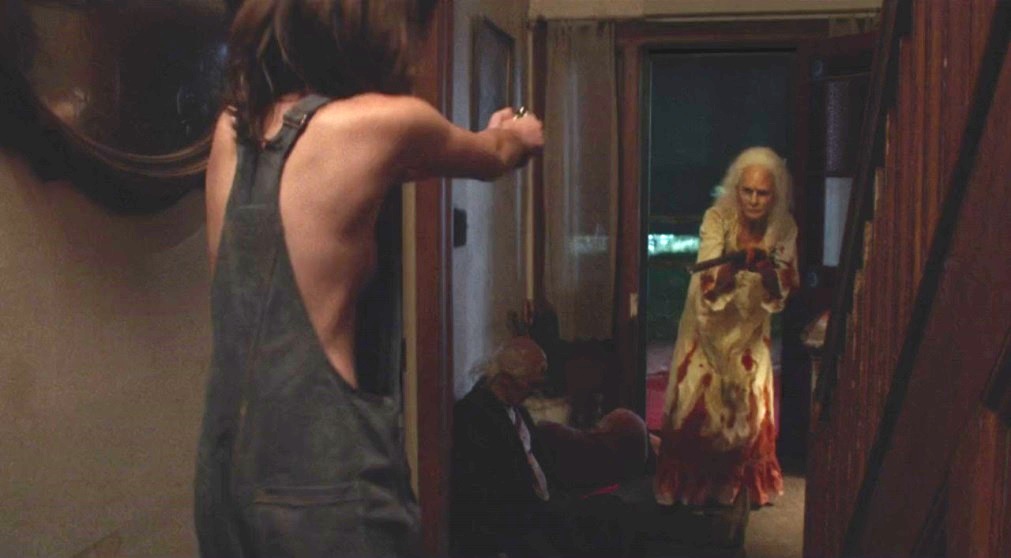
wizened woman, named Pearl (also Goth, caked in heavy make-up), and when Maxine
converses with her the crone seems to make sexual advances on her. During the
night, the percolating unease blooms into proper carnage.

West
has dipped his toe into provocateur waters before, as with the jarring but
period correct age difference between the middle-aged hero and teenage heroine
of In A Valley Of Violence, and here
he aims to go all out in cheery fashion with different varieties of ickiness.
To his credit, West tries to animate ideas with potential whilst recreating a
milieu, portraying different forms of reactionary gall and reforging much of
the cultural conversation around the schisms from that time into the stuff of
his narrative. Where
Hooper was careful in teasing apart the erotic and the horrific, as the Sawyer
clan in his film were far too devolved to even know what to do with the women
they assaulted other than make lunch meat of them, West makes the politics of
desire and difficulties of liberation pivotal to proceedings. Maxine is eventually
revealed to be the daughter of a ranting preacher (Simon Prast) constantly glimpsed
on TV screens in the rural region the would-be pornographers travel into. But
Maxine is following an alternative religion of Me Decade brashness as she hopes
the movie will make her into the star she already feels she naturally is.
Meanwhile Pearl is revealed, despite her age, to be a highly libidinous woman
who’s also a vicious psychopath, desiring youthful bodies of both sexes and
brutally laying claim to them. Her husband Howard, who’s grown too infirm
himself to sexually satisfy her, guiltily aids her. By having Goth play both
the lush young thing and the nasty crone, West makes obvious what is already
implicit, that they are different editions of the same thing. Maxine is
desperate to avoid becoming Pearl, who longs for her days of being an
attention-getting beauty and tries, Countess Bathory-like, to hold onto a final
flicker of youth by forcibly stealing it from the young.

Meanwhile
RJ is goaded to personal crisis when, after blathering on about his attempts to
inject artistry and meaning into the threadbare porno he’s making, Lorraine
suddenly expresses an interest in appearing in the movie. Wayne eagerly assents
to this, and talks RJ into to filming his girlfriend doing the nasty with
Jackson, after RJ’s rather horrified initial reaction. RJ breaks down sobbing
as he showers after the filming. These scenes are easily the best in X, reiterating the strong feel West
evinced in his earlier work for situating fairly ordinary if barbed character
travails, painted with the kind of humdrum palette familiar from indie cinema,
within the context of genre stories and images. There’s something really
interesting in this part of the movie, particularly as RJ is wryly portrayed as
a total geek who nonetheless reacts like any old-fashioned chauvinist cliché
when confronted by his lady’s transgressive urge, whilst good ole boy Wayne is
entirely accepting of all the new rules and calmly explains to RJ the dangers
of trying to control his girlfriend. Ortega also gets to throw off the neutered
vibe she was obliged to project as the saintly incarnation of Beta immigrant
spirit in Jon M. Chu’s In The Heights
(2021) in playing Lorraine, who seems initially to be the regulation prude (and
thus likely Final Girl) in the storyline only to dissect her own reactions and
the arguments of the others before eagerly signing on.

But
the rest of the film never finds a truly inspired way of dovetailing its
obsessively referential visuals and desire to explore new transgressive
dimensions with a blackly comic tone. Who knows how many stories like this have
led up to some hot young ladies chained up in some old bastard’s basement. The
notion of making the aged woman the killer and rapist is at once a bit obvious
as a twist, if also one with some potential, given the frame West builds around
it. But the potential power is sapped by West’s choice of casting two young
actors made up to look old, particularly in the case of Pearl, where it might have been
genuinely weird to see an actual old actress portraying such mania. I hate to
credit M. Night Shyamalan with anything, but he did a better job at making the elderly scary on The Visit (2016). Not
only that, but Howard and Pearl are rather vaguely characterised and insubstantial
as antagonists. Howard’s first appearance seems him acting like a pure hillbilly
caricature, waving a shotgun and fiercely telling the gang he doesn’t like
them, and Pearl hovers around acting batty, when the film would likely have
been far more effective if West had developed a note of strained politesse and distracting
hominess, much as Gene Jones helped provide for him on The Sacrament.

West’s
desire to channel the superficial textures of The
Texas Chain Saw Massacre, the specific vibe of sun-kissed seediness and down-home
menace, is
blatant, including
the ironically pastoral setting and gang of lissom youths rolling through
grassy landscapes in a van. West also seems to have watched Hooper’s
little-remembered follow-up Eaten Alive
(1976) with its more theatrical spectacle and the notion of a pet alligator
being used to dispose of unwanted corpses. West stages a random but wittily-handled
suspense sequence as Maxine goes skinny dipping in a waterhole on the property,
oblivious to the alligator slowly cruising towards her: West revels in his
nasty sense of showmanship as he repeatedly cuts to a high overhead shot to
observe the beast as it slides up behind her with stealthy patience. This
patience gives way to sudden shock when the animal, virtually forgotten,
suddenly pounces on a victim much later in the film. West tries a similar feat
when he zeroes in on a jutting nail awaiting the soft pad of Wayne’s foot,
although that’s another trick that’s been done better recently, in A Quiet Place (2018). The trouble is
that the harvested ‘70s Horror tropes never feel refreshed, or even that
cleverly enlarged upon. This goes also for many elements in the script:
Jackson’s recalled ‘Nam angst and Bobby-Lynne displaying her great capacity for
faking orgasms are vignettes that feel clipped out of other movies and
redeployed without any gloss of new meaning or personal intensity.

West
does however wisely skip around other clichés. Wayne isn’t revealed to be some
sort of brutish sleazebag or hypocrite, but is just an upbeat ringmaster
preaching erogenous-capitalist gospel. Surviving an ordeal in battling her ancient doppelganger doesn’t send Maxine scurrying back into the arms of the
patriarchy, but makes her double down on her tunnel-visioned self-devotion.
Snow, always an engaging performer, is particularly good as the slyly
intelligent and sardonic Bobby-Lynne, who reveals actual craft as both a
performer and a director, as when she gets RJ and Jackson to improvise a shot
where Jackson using a petrol pump becomes a visual double entendre. But there
was, for me, something badly lacking from X
in terms of the intended air of creepy suspense, which suggested West is a few
years too late to the party when it comes to the kinds of movies he’s
referencing, and a bit too lazy to weave the sustained mood of strained
tolerance and discomforting insinuation that’s necessary between the two
tribes. The actual violence, when it erupts, is gross and yucky in a Grand
Guignol fashion, but West’s attempts to be actually, properly disturbing don’t
come off. Even the revelation of some unfortunate young male hippie chained up
in the old couple’s basement, seemingly used as a love slave unto death,
achieves merely as a theatrical flourish rather than true nightmarishness.

The
quality that distinguished West’s earlier films was his capacity to approach
very familiar genre elements in an oblique, realistic, subtle manner, but here
he embraces the retro fetishism and the gleeful dip into old-school slasher
stuff to a degree that robs the film of any genuine quality of the crazed and
the unsettling, and resists any true emotional intensity and
catharsis, two qualities West’s model wielded in masterful quantities. A moment
like Pearl dancing over a slain victim’s body aims to evoke dizzy, what-the-hell weirdness,
but it merely hovers in air quotes. The film’s intended coup of grotesquery
comes as Howard finally gets enough mojo back to have sex with Pearl and the
two geriatrics screw whilst Maxine hides under the bed and tries to make a
silent escape. But, again, for me the intended mixture of queasy humour and
suspense didn’t actualise: it’s just too contrived and self-consciously outrageous.
West has become a technically accomplished filmmaker, and cinematographer Eliot
Rockett’s
images are strong, particularly in use of depth of field and perspective. The climactic scenes are
well-done in the manner of basic mechanics, with startlingly staged violent
twists, and the film’s ultimate punch-line finally gives the game away as a
freaky bit of cinematic horseplay: “One goddamned fucked-up horror picture.” Which is a fair enough thing to want to be. But whilst X isn’t
a bad film by any stretch, given the strength of its elements and overall
potential, I feel like it should have added up to much more.


)
0 Comments